Lithium Baths and Electric Bulbs
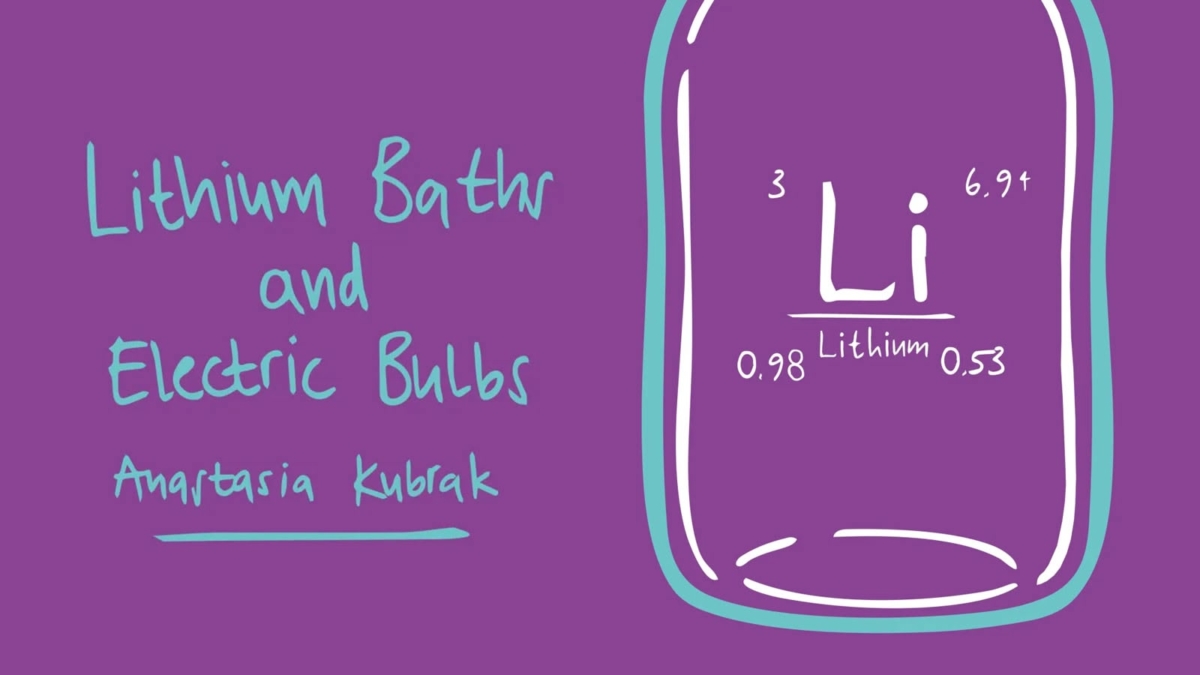
The exhibition follows lithium through centuries and asks: how do hopes and desires become attached to specific substances? Staged in the former Inhalatorium and Drinking Hall, the installation focuses on the act of bottling the mineral water, which transforms elements into commodities and valuable resources. Each bottle contains a promise, from increased bodily productivity to the ‘green’ extraction of minerals. But what would it take to un-bottle these waters? Could bathing in lithium be a strategy of resistance against the extractive industries and a practice for imagining different futures?
The exhibition draws on practice-based PhD research by Anastasia Kubrak at the Critical Media Lab at HGK Basel and the University of Arts Linz. Her doctoral research explores the role of lithium both as a critical raw material for the EU’s energy transition and as a medical substance, and documents European sites where the former lithium spas are currently being rediscovered as potential sites for lithium extraction. Previously, she co-curated the exhibition Lithium (2020) at Het Nieuwe Instituut in Rotterdam and co-edited the book Lithium: States of Exhaustion (2021) together with Marina Otero Verzier and Francisco Díaz.
Opening Programme
28 March 2026, Bagno Popolare, Baden (CH)
A festive evening featuring presentations, discussions, performances and communal soaking in thermal waters.
17:00
Introduction with Anastasia Kubrak and curator Kathrin Doppler
17:45 Apéro
18:15
‘Explorations of Porosity’. Performance by Yelizaveta Strakhova
19:00
‘Soaking as a Practice’. Roundtable in the bath with Jonas Köppel (Unversity of Bern) and Lydia Xynogala (HfG Karlsruhe)
Inviting visitors to join the bath, this conversation will explore soaking in lithium as a practice of elemental solidarity in the context of energy transition. Throughout history, mineral baths have served as prototypes for new forms of social relations. Could collective bathing become a strategy of resistance against the extractive projects, from lithium mining to the neoliberal wellness industry? What can ‘we’ do as researchers, artists and bathers, following substances through different histories and geographies?
20:00
Free bathing session
Speakers
Jonas Köppel is a post-doctoral researcher and lecturer in Social Anthropology at the University of Bern: My academic trajectory has been intimately tied to lithium. I conducted most of my fieldwork in Bolivia, where a lot of lithium is known to exist in the Uyuni salt flat. Not long ago, a socialist government launched an ambitious state project to recover it for the sake of the Bolivian people. I have mostly tried to understand that project from the perspective of the scientists and engineers who sought to implement it. Ever since, my conversations with them have inspired me to think again, and again, about what this particular mineral has become. An apparently simple element, lithium is now so full of meaning. It stands for global ambitions and contradictions; raises fears and hopes in distant places; is both risk and opportunity for different people. Whenever I hear people talk about it, I remember how lithium draws the entire world into a single conversation.
Lydia Xynogala (Dr.sc ETH) is an architect and researcher working between Zurich and Athens; currently postdoc lecturer at the Academy of Architecture in Mendrisio and at the Academy of Art and Design in Karlsruhe. Her dissertation “Take Care” on the history of Greek mineral springs and baths as a doctoral fellow at gta Institute ETH, was nominated for the ETH Medal and exhibited at gta exhibitions ETH Zurich, ZAZ Bellerive and Mendrisio Academy. Her architecture practice, ALOS, has been supported by fellowships from the New York Foundation for the Arts, the Onassis Foundation and the Greek Architecture Award. She has lectured and published her work internationally and is the founding director of the Zurich based non-profit association Friends of the 750 Mineral Springs of Greece.