Non-Public Publics
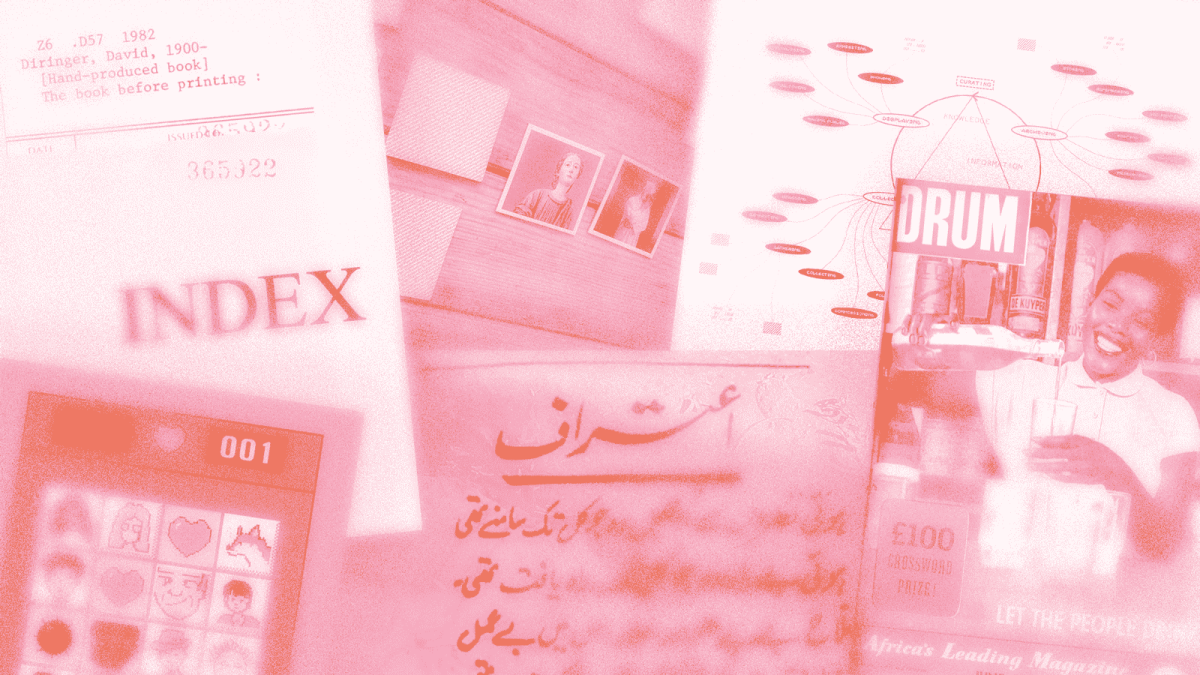
Through workshops, talks, and conversations the public program intends to discuss and rehearse modes of smuggling and nesting, negotiating temporalities and communal distribution – intimate and meaningful social worlds that are the result of all engaged publishing efforts. These rather invisible aspects are approached from different angles and within different formats; publishing can here be understood as pedagogical tool, as a means to unsettle logics of classification, or as a way to diagram operations of collecting, hierarchizing, and displaying objects in institutions. It can take on the form of a game as method for practice-based research or become a Long Table discussion to collectively imagine coalitional frameworks for understanding our intimate and organizational needs.
Non-Public Publics is organized by the Make/Sense PhD Program together with the Institute Experimental Design and Media Cultures (IXDM) at HGK Basel and nested within the MESH Festival program “Infrastructures of Care”.
The entry is free; all and everybody is welcome.
For the workshop sessions, we kindly ask you to register. Please see the notes in the program below.
Program Overview
Thursday, 15 October
10:00–12:00 | Workshop with Shivangi Mariam Raj
Smuggling the Future: Publishing as Creation of Slow Time
14:00–16:00 | Workshop with Erin Honeycutt / Cutt Press
The Book Before Printing
18:00–20:00 | Input by Eric Otieno Sumba & discussion with Shivangi Mariam Raj and Erin Honeycutt
Beating (Beyond) Apartheid
Friday, 16 October
10:00-12:00 | Workshop with Magda Tyżlik-Carver
Curating Data, Fermenting Ecologies
Parallel Workshops on Game as Publishing:
14:00–16:00 | Workshop with Qingyi Ren and Jisoo Lim
MINE/MINE
14:00–16:00 | Workshop by Benedikt Reichenbach
Double Double. A Pop-up Critique of Visual Economy
18:00–20:00 | Long Table Conversation facilitated by T.L. Cowan & Jas Rault
Nesting and Nested Infrastructures: A Long Table Conversation on Intimacies, Needs, Care, Accountability, Vigilance, and Rest
Thursday, 15 October
Smuggling the Future: Publishing as Creation of Slow Time
Workshop with Shivangi Mariam Raj
Deploying a volumetric approach to both language and architecture, this talk focuses on publishing practices under colonial and carceral contexts. It examines tactics, forms, and materialities of publishing as a political instrument and a pedagogical tool. In thinking about how captives and prisoners decelerate time, create channels of circulation amidst temporal interstices, and smuggle the temporalities of wait, it looks at publishing’s potential for defying the settler logics of containment and fragmentation. Because space and time are so tightly interlaced in a prison, an attack in one dimension necessarily weakens the other, thereby bending the spacetime continuum that grants the prison its imperishability. The talk will be followed by a workshop that carries this temporal rhythm of the dark and the negative into developing a cumulative text with a language that grapples with its own failure, a language that is obscure to the perpetrators, a language that does away with the need to insist on evidence and rather works to restore the link between meaning and mourning, between the world of the living and the world of the dead. Together with the participants, we will create a publication-object by using eclipse as methodology, by building counterarchival densities, and by reflecting on the volume of absence.
Shivangi Mariam Raj is a writer and cultural worker based between Delhi and Paris. As an independent researcher, she is interested in visual and spatial cultures of violence against the minoritized and the colonized across South Asia and West Asia. Her practice dwells in the negative, combining approaches in sociolinguistics, sound, photography, countercartographies, and translation. She utilizes essays, poetry, and reportage for individual memory to coalesce into a broader inquiry of the politics of public remembering. Her work has consistently challenged the foundational mythologies of the Indian state and its networks of accumulation across caste, capital, and colony. She continues to focus on spectral temporalities as forms of resistance in Kashmir. She is a university dropout and was previously working with Oxford University Press. She has been the 2024–25 Editorial Fellow for Logic(s) Magazine at the INCITE Center of Columbia University as well as the recipient of the Graham Foundation’s 2024 grant for research for her project, “Shadow Thresholds: Architecture of Ruin in India.” Her work with The Funambulist focuses on the politics of space and bodies. Currently, she is at work on a manuscript that examines the material and political economy of rubble across its aesthetic, architectural, and affective registers.
Registration
https://eventfrog.ch/en/p/festivals/other-festivals/workshop-by-shivangi-mariam-raj-smuggling-the-future-7503753462875694844.html
Please also send an email to jonas.vonlenthe@fhnw.ch with a short rationale outlining your background and motivation to participate. Accepted participants will be informed by October 5.
The Book Before Printing
Workshop with Erin Honeycutt / Cutt Press
The index of The Book Before Printing (1982) will guide a speculative history of book culture, the origins of writing, and authorship. We will use this index as an inventory of forms to select from, arrange, and press into new writing. Working through categories like scribe, seal, colophon, and palimpsest, participants will build texts that borrow the index’s own logic of classification while unsettling it. What does it mean to write “after” a form rather than as its sole originator, following Sezgin Boynik’s argument that bibliography is not a neutral record but a collectivizing, politically charged act.
Erin Honeycutt is a writer and bookmaker based in Berlin, where they run CUTT PRESS. They have taught across art and writing, including Video Art at the Iceland University of the Arts and the “Radical Publishing” seminar at the UdK Berlin. They are the author of the poetry chapbook Dear Enheduanna (2025, Ugly Duckling Presse) and the prose and poetry collection Night School (2026, MA BIBLIOTHÈQUE), as well as numerous self-published ephemera.
CUTT PRESS is a publishing project founded in 2020, growing out of a bookselling practice at Hopscotch Reading Room, a Berlin bookstore for queer and anticolonial perspectives. The press is curious about bootlegging aesthetics, the materiality of writing, and an ongoing dialogue with its tools.
Registration
https://eventfrog.ch/en/p/science-and-technology/workshop-by-erin-honecutt-the-book-before-printing-7503748447998094898.html
Please also send an email to jonas.vonlenthe@fhnw.ch with a short rationale outlining your background and motivation to participate. Accepted participants will be informed by October 5.
Beating (Beyond) Apartheid
Input by Eric Otieno Sumba, followed by a discussion with Shivangi Mariam Raj and Erin Honeycutt, moderated by Lucie Kolb and Jonas von Lenthe
South Africa’s DRUM Magazine, founded in 1951, was reaching an unprecedented 73,657 buyers by 1955, making it Africa’s most widely circulated magazine in any language. In its prime, each issue was passed on to up to 9 others on the streets, in the clubs or on the trains, leaving an indelible imprint with a winning mix of investigative features, serialized fiction, mild, scandalised erotica, and compelling images from pioneering photographers which showed life as it was amidst the propaganda of the apartheid regime. After ten years of sustained state repression, the magazine was banned between 1965 and 1968 but was revived and had another moment in the late 1980s before its steady decline, and ultimate conversion into a human-interest online magazine (and pathetic shadow of its former self) in 2020. DRUM’s back issues remain a powerful reminder that political print publications can circulate widely and mobilize masses. In moment of renewed political repression and receding political freedoms, this contribution questions the role of publishing practices in the context of political adversity and repression amid an entirely transformed publication landscape.
Eric Otieno Sumba (Postdoc) is a writer and independent researcher with a background in social theory, political economy, postcolonial studies and art criticism. His PhD Project (2017–2023) examined the social movements in the anti-globalization era, examining the relationship between mobilization, protest and institutional reform. In his current role as editor (publication practices) at Haus der Kulturen der Welt (HKW), his research has culminated in editorial projects including “Global Fascisms” (co-edited with Cosmin Costinas and Bonaventure S. B. Ndikung, 2025), “Destination Tashkent: Experiences of Cinematic Internationalism” (co-editied with Can Sungu, 2024), and “Echos of the Brother Countries: Visions and Illusions of Anti-Imperialist Solidarity” (2024) among others. Informed by and intersecting with the aforementioned projects, his ongoing research focuses on the networks, nodes, and infrastructures of anti-hegemonic publishing practises in 20th century pan-african and internationalist initiatives including the Pan African Congresses and the Congresses of Black Writers and Artists.
Moderators
Dr. Lucie Kolb is a scholar of critical publishing with a background in visual arts, art history, and cultural studies. Her work involves studying and producing artistic knowledge, e.g., practice-oriented writing and transversal publishing. She is interested in identifying, studying, and developing infrastructural practices with a particular focus on knowledge infrastructures such as libraries, collections and archives. Lucie works with practice-based methods, archival work, and field studies. Her research addresses hidden mechanisms and structures that create social injustice in knowledge organizations and considers how collective work on infrastructures of knowledge is foundational for common intellectual practice and proposes ways to conceptualize infrastructural imaginaries otherwise.
Jonas von Lenthe is the founding editor of the Berlin-based publishing house Wirklichkeit Books, where he edited various publications, including Dagmar Herzog’s The New Fascist Body, Hierarchies of Solidarity (2024) and English in Berlin – Exclusions in a Cosmopolitan Society (2022) by Moshtari Hilal and Sinthujan Varatharajah, as well as Rejected. Designs for the European Flag (2020). From 2022 to 2024 he held the position of the head archivist at Kunstverein München together with Johanna Klingler. He works as research assistant at the Critical Media Lab in Basel, where he co-edits the essay series What Is Critical Publishing? together with Lucie Kolb.
Friday, 16 October
Curating Data, Fermenting Ecologies
Workshop with Magda Tyżlik-Carver
Working with diagrams is to hold things open to many possible interpretations. This workshop start from the Curating Data diagram, a way of mapping curatorial operations such as collecting, classifying, archiving and displaying as relations that never quite settle. Diagramming practice lets us navigate between differently sourced and attributed readings of the same thing, rather than settling on one, seemingly preferred answer or description. Curating Data diagram treats this non-closure as affordance not a problem to fix. We will test this process by starting from a jar of ferments that are alive and changing. We will trace what’s in the jar and what surrounds it: the hands holding it, tastes of it, microbes transforming it. And we will see how open and legible can the diagram stay.
Magdalena Tyżlik-Carver is Associate Professor of Digital Communication and Culture in the Dept. of Digital Design and Information Studies, and co-Director of the Centre for Critical Data Practices, both at Aarhus University. She works with the concept of posthuman curating to inquire into computational and data cultures. Currently her focus is on the digital transformation in knowledge making practices driven by AI technologies, semantic web, and data infrastructures. As a curator and researcher she develops participatory methods for data practices beyond BigTech extractivism and expansive infrastructural politics by working with speculative methods and open data principles (Fermenting Data, common practice), as well as knowledge graphs, diagrams and guides (Curating Data). As an independent curator she curated exhibitions and events including: Fermenting Data: Aaarhus 8000-8220 (2021), ScreenShots: Desire and Automated Image (2019), and Movement Code Notation (2018). She is co-editor of Curating Superintelligences. A Reader on AI and Future Curating (2025) and Executing Practices (2018), both published by Open Humanities Press in Data Browser series. She is also co-author of Boundary Images (2023), published by Minnesota Unviersity Press. She regularly writes about digital and visual cultures with focus on digital images and curating, contributing to edited collections, journals and magazines.
Registration
https://eventfrog.ch/en/p/festivals/other-festivals/magdalena-tylik-carver-curating-data-fermenting-ecologies-7503754579286193892.html
Please also send an email to jonas.vonlenthe@fhnw.ch with a short rationale outlining your background and motivation to participate. Accepted participants will be informed by October 5.
Two parallel workshops on Game as Publishing
MINE/MINE
Workshop with Qingyi Ren and Jisoo Lim
MINE/MINE originates from a series of participatory board-game workshops that explore queer coming-out experiences through collective play. The workshop takes the form of a tabletop storytelling game using prompt cards and simple interaction mechanics. Through turns of play, participants respond to scenarios and questions related to themes such as secrecy, risk, support, and community, sharing personal reflections or speculative situations.
Within Playable Publishing: Game as Method for Practice-Based Research, the game functions as a research device and publishing method. Gameplay facilitates conversation while producing narrative fragments, notes, and shared reflections. These materials are collectively documented and become part of an evolving archive of queer coming-out stories.
Rather than treating participants as interview subjects, the workshop invites them to take part as players and co-authors, generating knowledge through play while forming a temporary space of mutual listening, care, and safety.
Before You Join: We ask everyone to approach this space with openness and respect. Any form of hatred or discrimination will not be tolerated.
Qingyi Ren (任晴宜, They/Them) is a Researcher and artist at the Critical Media Lab Basel. They work at the intersection of AI, digital culture, and queer theory, examining how algorithmic systems shape and misrecognize gender and identity through artistic research on facial recognition, machine translation, and generative AI.
Jisoo Lim (she/they) is a game designer and researcher currently pursuing a PhD in Digital Humanities at the University of Basel. Her work combines game design, critical media studies, and practice-based research to explore the experiences of marginalized communities within social and religious contexts. Their works, including Sena and Their Garden, have been showcased at international festivals such as IDFA DocLab(NE), A MAZE(DE), and London Games Festival (UK), where they have been recognized for their experimental approach that bridges design research and interactive storytelling. Their broader interests include queer temporality, playfulness, and the role of digital storytelling in enabling social intervention and community-driven forms of knowledge production.
Registration
https://eventfrog.ch/de/p/festivals/weitere-festivals/workshop-by-qingyi-ren-and-jisoo-lim-mine-mine-7503755345266800268.html
Please also send an email to jonas.vonlenthe@fhnw.ch with a short rationale outlining your background and motivation to participate. Accepted participants will be informed by October 5.
Double Double. A Pop-up Critique of Visual Economy
Workshop by Benedikt Reichenbach
Double Double. A Pop-up Critique of Visual Economy is a practice-based research project developed as a memory game with 22 non-identical pairs from a delirious variety all across history of visual culture, publishing, design, and architecture.
If modernity is one thing, it is divisiveness. Identity as we know it emerges from this experience, from the complex dynamic of domination and liberation and the struggle of who-gets-what. While “we all have become cameras” (Deborah Levy), the game with doubles plays with this complexity. Along the development of the terms “double image” and “visual economy”, Double Double explores the social, political, and material dimensions of image production and consumption.
Conceived as a podium event, the project proposes an experimental, collective mode of research into the politics of representation. The form of the game addresses and lays out the topic non-synthetically, non-conclusively, as an easy-to-access jumping board for spontaneous personal association, where even if you loose, you win.
Benedikt Reichenbach has worked as a graphic designer and editor since 2008, following studies in history and philosophy. In 2015–16, he was a grantee of the Graham Foundation for Advanced Studies in the Fine Arts, and a participant in the Whitney Independent Study Program (ISP). In 2014, he published Harun Farocki Diagrams. Images from Ten Films (Verlag der Buchhandlung Walther König, Cologne); in 2017, Pasolini’s Bodies and Places (Edition Patrick Frey, Zurich). In 2020, his research project on the French graphic designer Jacques Daniel (1920–2011), who began his career producing false papers for the French Resistance, received funding from the Centre national des arts plastiques (Cnap).
Registration
https://eventfrog.ch/de/p/festivals/weitere-festivals/workshop-by-benedikt-reichenbach-double-double-7503755870062281728.html
Please also send an email to jonas.vonlenthe@fhnw.ch with a short rationale outlining your background and motivation to participate. Accepted participants will be informed by October 5.
Nesting and Nested Infrastructures
A Long Table Conversation on Intimacies, Needs, Care, Accountability, Vigilance, and Rest
Facilitated by T.L. Cowan & Jas Rault with Mesh Festival Presenters and Participants
Working in the Long Table format created by performance artist Lois Weaver, T.L. Cowan and Jas Rault will facilitate a conversation about nested intimate and accountable infrastructures, working with “nesting” as both metaphor and method for building and maintaining protective publics, in which (drawing on the work of Wendy Hui Kyong Chun) we can be vulnerable without being attacked. “Nesting” in an Anglo context generally refers to collecting, cultivating, and enjoying the benefits of our labours in a cozy, beloved, hidden home space. However, when we look to avian ecologies and lifeways, we learn that nesting is an instinctive practice of building a protective space from found materials in the immediate environment, in order to hide and protect adult birds, as well as eggs to be laid and young to be fed, warmed, shielded and fledged. Thus, in addition to being designed for nurture and rest, nests are also sites of hyper-vigilance, intense labour and expertise. Whether in tactical clusters, colonies or isolation, nesting is an infrastructural method for creating a “protective public” that gathers by affinity as a response to exposure-sensitivity.
In this Long Table conversation we will gather Mesh Festival presenters and participants to reflect on nesting practices and nested infrastructures, and to collectively imagine coalitional frameworks for understanding our intimate and organizational needs. Together, we will share and co-create methods for responsive and accountable care in the context of ongoing and intertwined everyday violences of predatory technocapitalism.
T.L. Cowan (she/they) is an Associate Professor of Media Studies in the Department of Arts Culture and Media and the Faculty of Information at the University of Toronto, as well as a performance and video artist. Her creative-research practice focuses on performance and archival ethics and temporalities and moves between page, stage, and screen, including the “GLITTERfesto,” which is featured in the exhibition GLITTER, at the Museum für Kunstund Gewerbe Hamburg (2025); Gewerbemuseum Winterthur (2026); Basel Historical Museum (2027).
Jas Rault (they/them) is an Associate Professor of Media Studies in the Department of Arts, Culture, Media (UTSC) and the Faculty of Information at the University of Toronto. Their research focuses on trans- feminist and queer (TFQ) digital praxes and protocols; architectural and media histories of settler coloniality, white supremacy and sexuality; aesthetics and affects of social movements.
T.L. Cowan and Jas Rault are co-authors of the book Heavy Processing, about trans- feminist and queer (TFQ) digital research methods and ethics (open access, punctum books, 2024), which is the first book in series about TFQ technologies for thinking, living, and being together, to be followed by Nesting and Checking In. Together they co-edited “Metaphors as Meaning and Method in Technoculture,” a special section of Catalyst: Feminism, Theory, Technoscience (Fall 2022), and co-direct two online research environments: the Cabaret Commons, and the Digital Research Ethics Collaboratory (DREC). They are co-authors of the “Feminist Data Manifest-No,” and co-creators of the stay-at-home domestic portraits project, Fancy Fridays.