Agnotological Investigation & Cartography of Darkness from the Lands of Liberation
Colloquium & Workshop
Sherena Razek studies seed archiving, soil smuggling, hunger strikes, prison breaks, subterranean imaginaries, and sinkhole eruptions as life sustaining practices of Indigenous Palestinian refusal to capitulate to empire. Through counter mapping archival photographs, filmic interventions, close readings of personal encounters and disruptive gestures, she rearticulates these practices as different expressions of human and more-than-human elemental intifada, or uprising that chart pathways towards unmaking the Anthropocene.
Nisrine Chaer will trace the global supply chain of genocide as experienced in Lebanon by discussing three case-studies: The Pager Massacre of 2024, the discourse and political economy of the independent media sector, and burgeoning AI governance schemes. Looking at this triad side by side exposes the global economy, and hence internationalist responsibility, that produces these emerging forms of Zionist technocolonialism.
Drawing on her situated experience and practice, Lebanese journalist and writer Noor Sleiman examines the ethical responsibilities of journalism and the politics of witnessing and documentation amidst an ongoing genocidal assault. She considers how journalistic and contra-visual practices (that refuse image-making) can resist domineering regimes of erasure, disinformation and dispossession while providing counter-narratives in manners that honour the dignity of the people of the land and oppose the instrumentalization of suffering.
Schedule
14:00–14:20
Welcome (Johannes Bruder) & Intro Cartography of Darkness (Eazuka Khazrik).
14:20–15:00
Talk by Sherena Razek + Q & A
15 min Break
15:15–16:00
Talk by Nisreen Chaer + Q & A
15 min Break
16:15–17:00
Talk by Noor Sleiman + Q & A
(in arabic, with live translation)
Workshop
Thursday, 8 October, 09:30–12:30 & 14:00–17:00
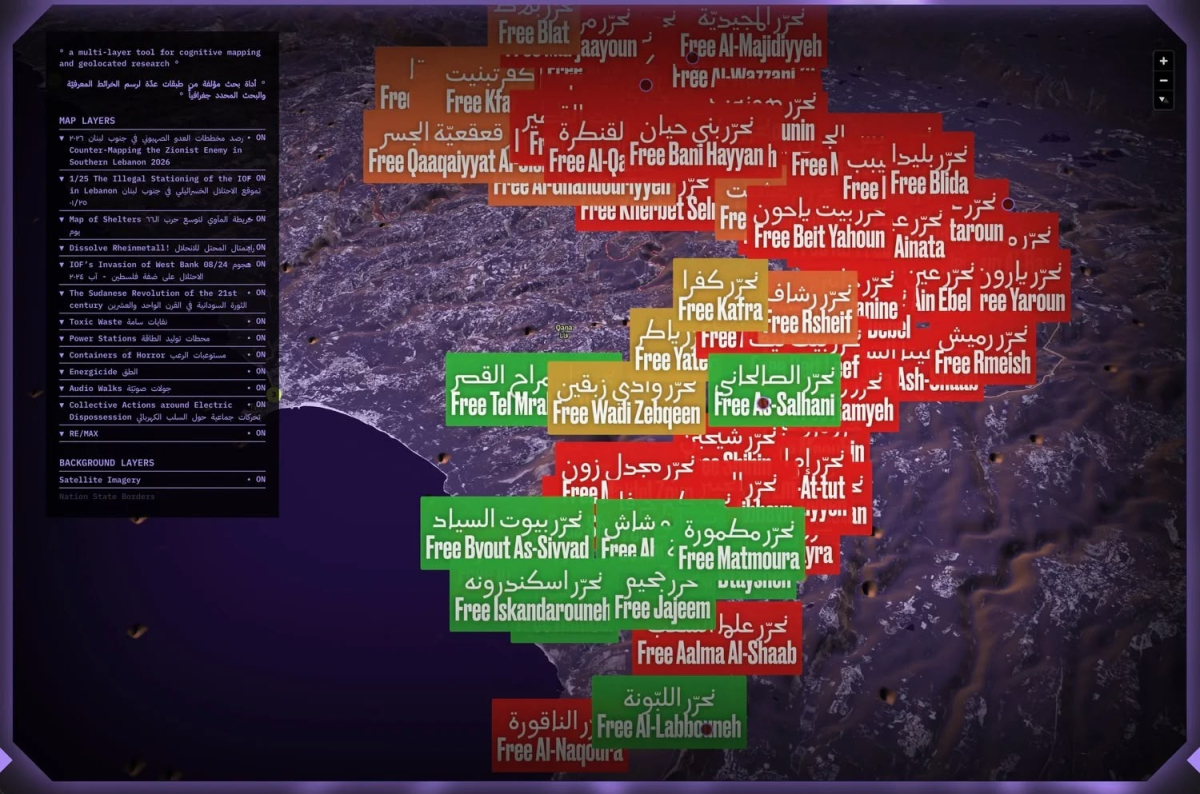
On day two, we’ll dive deeper in a workshop setting with Eazuka Khazrik, drawing on the field of agnotology (the study of the production of ignorance and uncertainty) and the philosophies of its much older Arabic counterparts تجهيل (manufactured ignorance) and تجاهل (the bedrock of avoidance politics) to arrive to investigative techniques and strategies of documentation that can resist the necropolitical obscurations our time. Probing a multiplicity of techniques from cognitive mapping to geolocated research and multi-modal respositories, we will explore together setting up and maintaining platforms for collective investigation and movement building.
Guest Speakers
Sherena Razek is a diasporic Palestinian feminist educator, scholar, activist, and labor organizer. She is Assistant Professor of Women’s, Gender, and Sexuality Studies at UMass Boston and previously held a President’s and Andrew W. Mellon Postdoctoral Fellowship in the Department of Gender Studies at UCLA. She received her PhD from the Department of Modern Culture and Media at Brown University where she was the President of the Graduate Labor Organization and co-founder of the Palestine Solidarity Caucus. Her research focuses on Palestinian visual culture, anti-imperialist struggle, and decolonial feminist ecologies.
Nisrine Chaer holds a PhD in gender studies from the department of Media and Culture Studies at Utrecht University. She is also an instructor and a research fellow at the Department of Communication, Mobility and Identity at the Lebanese American University.
Noor Sleiman is a Lebanese journalist and writer who has worked as a correspondent, producer, and communications officer for a number of local media organizations and international organizations, covering issues related to women’s rights, human rights, and freedom of expression. She holds a master’s degree in Journalism and Media Studies from the Lebanese University. She currently focuses on documenting people’s stories and experiences of marginalization and erasure amid the ongoing Israeli genocidal war in Palestine and Lebanon. Her work is grounded in steadfast belief in the power of narrative and storytelling to preserve memory and amplify voices whose silencing is sought and designed. Noor is a co-founder and senior journalist at Tara Platform.
Suggested Reading
- Chaer, Nisrine. “Affirmations of Life’ Confront Israel’s ‘Right to Kill.’” The Public Source, 24 Sept. 2024.
https://thepublicsource.org/blog/lebanon-front/affirmations-life-israel-right-kill - Khazrik, Eazuka. “‘Anosh Adur’: A History of Ammonia I.” Cartography of Darkness, 4 Aug. 2023.
https://dark.society.systems/contribution/a-history-of-ammonia/ - Razek, Sherena. “Elemental Intifada: How Palestine Unmakes the Anthropocene.” The Markaz Review, 4 Sept. 2026.
https://themarkaz.org/elemental-intifada-how-palestine-unmakes-the-anthropocene/ - Suleiman, Nour. “A Letter from a ‘Safe Place.’” Al Rawiya, 18 Dec. 2024.
https://al-rawiya.com/a-letter-from-a-safe-place/ - Unspecified. “Oracle’s Recent Deals with Lebanon × Oracle’s Decades-Long Corporations with the Zionist Entity.” Cartography of Darkness, 15 Dec. 2025. https://dark.society.systems/contribution/timelineoforacle/
- Vimalassery, Manu, Juliana Hu Pegues, and Alyosha Goldstein. “Colonial Unknowing and Relations of Study.” Theory & Event, vol. 20, no. 4, 2017, pp. 1042–1054.